



Earth Resistivity
The resistance to earth of an electrode is directly proportional to soil resistivity & inversely proportional to the total area of contact established with the soil for fixed land areas. Soil resistivity is a function of several factors. These include the type of soil, moisture content, temperature, mineral content, granularity & compactness. Usually moisture & mineral content are the only factors that can be influenced by any practical control concept. Ionisation of soil & moisture retention are required to reduce soil resistivity, but the mineral content has the most dramatic influence. Ionisation is the first step to reduce soil resistivity.
The next step is to increase the moisture retention capacity of the soil. These are the two recommended techniques for reducing earth resistivity.
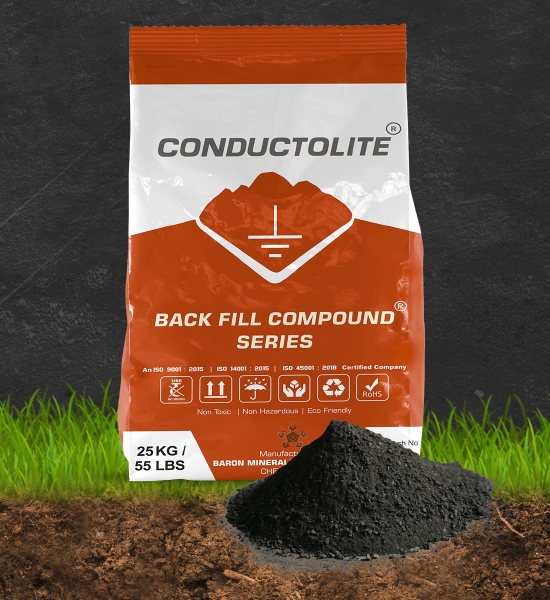
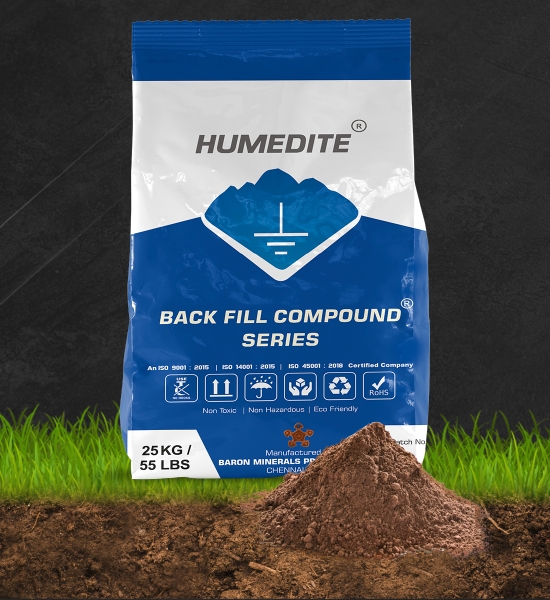
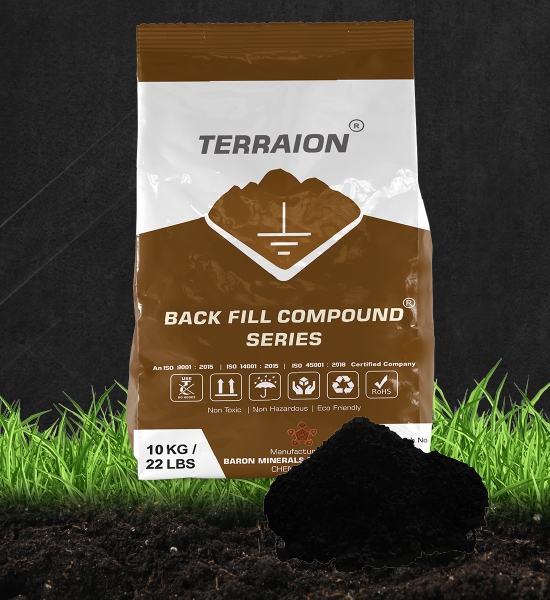
Baron BackFill Compound(s)®
These are earth enhancement compounds, having different properties that can be chosen | selected as per soil & its other properties. Essentially, an ideal BFC should have low resistance, excellent moisture absorption and retention capabilities, and thermally stable. Although, earthing can be provided even without the use of BFC, however, for better performance it is suggested to use the BFC while providing the earthing system.
Baron has developed five different types of BackFill Compound(s) for three dimensional augmentation in electrical earthing system. This system should achieve low group resistance value for long periods where obtaining a satisfactory earth resistance has always been a problem in areas of poor soil conductivity.
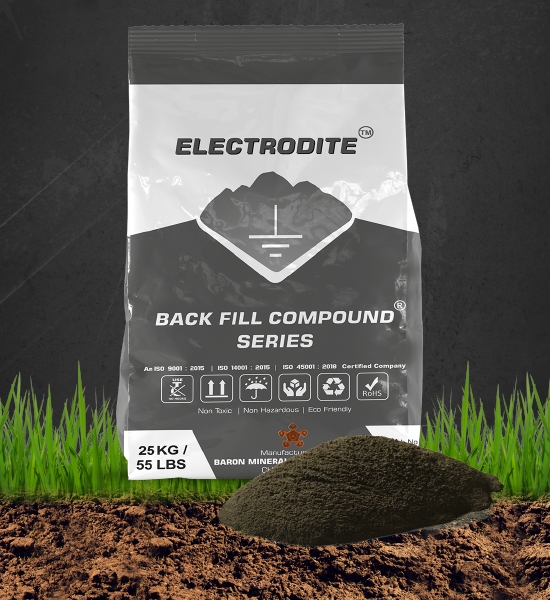

 Resistivity : < 5 ohm-metre (In ideal moist conditions) ; > 5.