
Soil Testing Services | Ashlok Chennai Ensuring Effective Grounding

Ashlok’s Earthing System

The establishment of a reliable earthing system plays a vital role in electrical system design. Ashlok's procedure for commissioning an earthing system involves a visual examination, continuity testing, and Earth Resistivity testing. These steps are carried out to verify compliance with the design specifications and to assess the condition of earth conductors and connections.
Soil Resistivity Test

Soil resistivity is a crucial factor in designing the grounding system for new installations to ensure they meet your specified ground resistance standards. Various factors, such as soil texture, mineral composition (ion content), grain size, compaction, temperature, and moisture content, influence soil resistivity. Ashlok offers a range of Backfill Compounds that can enhance the earthing resistance in cases of poor soil conditions, enabling you to achieve the desired level of grounding. It is advisable to place the safe earth electrodes as deeply as possible into the earth, preferably in deeper strata.

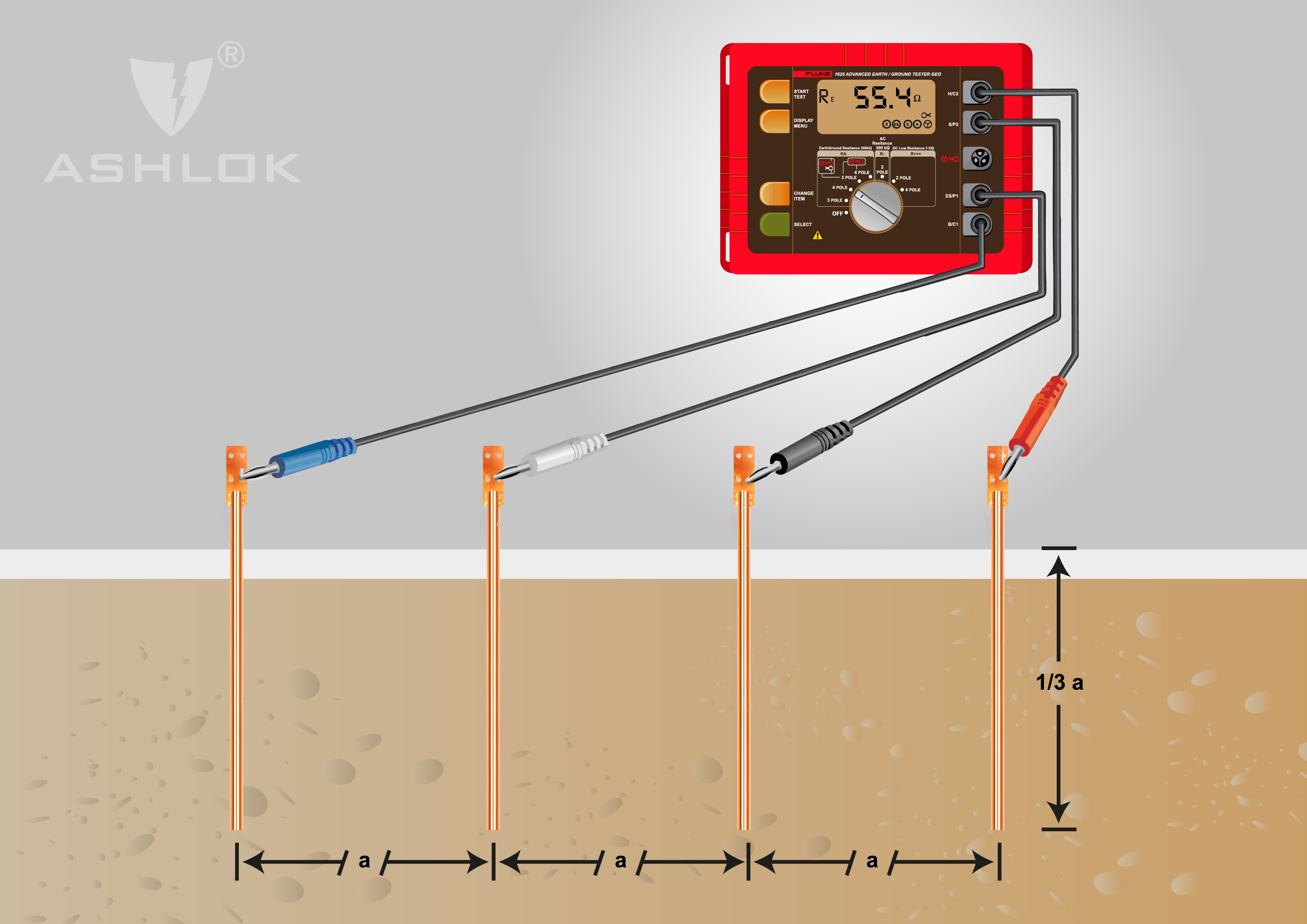
Calculating soil resistivity Wenner Method of calculating soil resistivity,


  • ρ= 2 π A R
  • where:
  • ρ= the average soil resistivity to depth A in: ohm-cm.
  • π = 3,1416.
  • A = the distance between the electrodes in cm.
  • R = the measured resistance value in ohm from the test instrument.

Commonly addressed as four-point method, four small electrodes spaced at equidistant intervals a are driven vertically into ground, all at depth b. A test current I is passed between the two outer electrodes and the potential V between the two inner electrodes is measured. Then V/I gives the resistance R in ohms. The tester automatically calculates the soil resistance using Ohm’s Law (V=IR).


image

Soil Resistivity Test FAQ

What is the significance of a Soil Resistivity test?

Soil resistivity measurements serve the following purposes:

  • Determining the earth resistance for a planned Substation or Earthing system installation
  • Assessing potential gradients, including step and touch voltage.

Varieties of Soil Resistivity Testing:

Earth resistivity measurements are useful in,

  • Uniformly Distributed or Wenner Configuration
  • Non-uniformly Distributed or Schlumberger-Palmer Configuration
  • Single Rod Testing Method